
Pigs require protection from the elements and predators.
Shelter and Bedding
A basic shelter is sufficient as long as it is weatherproof and dry inside. Protection from the wind from at least three sides with room to get out of drafts and warm straw bedding to insulate and cozy up in. To a lesser extent we also use shavings to soak up urine as needed (i.e., for young piglets that “wet the bed”, an established bathroom area during cold weather, or for a sow locked up at night with her piglets).
There should also be adequate ventilation and circulation. We have seen everything from wood A-frames, sturdy metal hoop structures, and calf huts used appropriately. An appropriate shelter will depend largely on what you are sheltering your pigs from – severe winters, ground frost, rain, mud, heat, wind, etc.
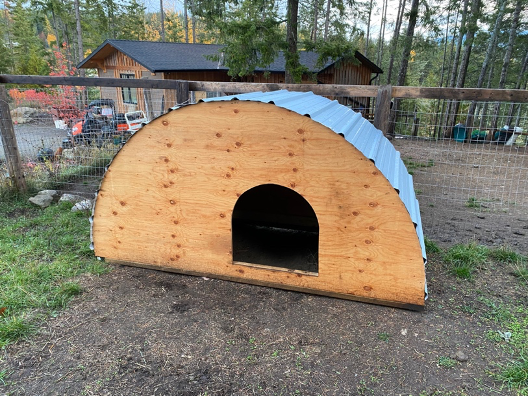
Our pigs typically shelter in a 3.5-sided shelter or small barn with the door left open. We add a layer of shavings or straw to the bottom of the shelter to insulate them from the ground. The size and kind of shelter you have will depend on how many pigs you have and your local conditions and resources. There should be enough space for them to all lay down and to get around each other to get out. They are rather snuggly and will huddle up together year-round – even during the sweltering summer heat. They are also very clean and will not poop where they sleep if given adequate space. Although, they can get a little sloppy in the winter months when it is cold going outside first thing in the morning – can you blame them?
We work with what we have. Our shelters include everything from stalls to loafing sheds. Here are a few of the shelters we use.


Seasonal Considerations
Kunekune can do well in climates across Canada with proper shelter and that shelter may look different than what is required on Vancouver Island, in our temperate rainforest. Here, it rarely dips down to -10 degrees Celcius for a week of winter or over 30 degrees Celcius for more than a week in the summer.
During the winter we are diligent to provide several inches of straw bedding. They have straw bedding year-round, but we are extra generous when it is cold outside. Our friends to the North and inland from us take additional measures such as insulating entire walls with straw. Straw insulates because it is hollow, hay is solid and much less effective – you want straw for warmth.
During the summer we are extra diligent to keep water buckets topped up. Pigs can’t sweat and can overheat without means to cool themselves off. Dehydration can lead to fatal salt toxicity too, so keeping your pigs well hydrated is essential. in add to clean, cool water, we also provide a wallow for them to use to cool off. Allowing them to dig a mud wallow and keeping it topped up with water is a great way to stay cool and mud helps keep the mosquitos at bay. Wallows are easy to make – the pigs do all the work. Leave a hose on long enough to dampen the earth and add more water as the wallow develops, the pigs will do the rest of the work to create a wallow. The best way we have found to do this is to allow our water buckets to overflowing several times throughout the day using a timer. It keeps the water buckets clean and topped up, and trickles in fresh cool water to refill or expand the wallow through the day.
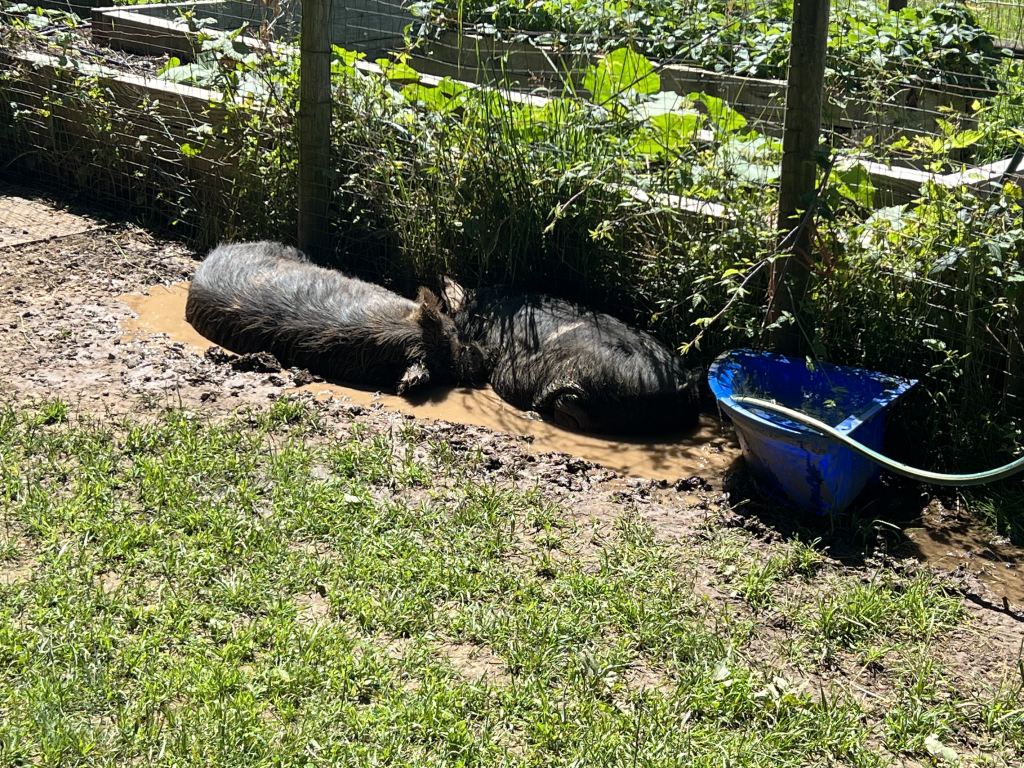
For most of the summer where we live, with our stocking rates, and soil, having the timer switch on for 2 minutes every 2 hours during the day seems to do the trick. This cools and fills the water buckets and is enough to overflow and fill our wallows without wasting too much water. How you do this and how much water you use will depend on your herd density, soil type, and weather, but this method seems to work really well for us in a few different areas. We know they need more water when the water buckets start getting flipped and that they have enough when they stop tipping their buckets. Bucket tipping is a good indicator for us and usually starts in the spring and ends as soon as they have constructed what they think is an appropriately sized wallow. We just “listen” to our pigs.
The one time I am a bad “listener”, is when I have a sow and litter during a heatwave (which I try to avoid, but it happens). New piglets are not the best at navigating mud and water and a wallow looks like one huge piglet death trap to me. During hot days over 30 degrees Celcius, sows get acess to a mister, fan, shallow water bucket (that I have to regularly fill because they’ll dump it and try to wallow in it), and a regular hose down to us make sure the ground is cool and their bodies are cool. I’ll mist the piglets too if they start panting – they hate it but it drops their body temperature temporarily to give them some reprieve. Fortunately, right now where we live we just get a week or two of extreme heat every summer.


I see pictures sometimes on the pig pages of pigs annoying their owners by tipping water dishes or laying in dishes instead of using topped-up kiddie pools that are provided. To me, they are just begging for a better alternative to the pool. We don’t fight the water bucket tipping and insist on them using pools, we embrace their piggy desires and let them have what they want. We are a bit strategic though and have all our watering stations in cooler areas with shade and out of the way where they can do their thing and not be underfoot.
I am not inherently opposed to kiddie pools. I use them occasionally when I shift pastures in the summer and there is no established wallow yet or if I change a herd composition and there are more pigs than the immediate room in the wallow. A pool is sometimes the best option I have while they work on making a wallow, but if given the choice, all my pigs prefer a good wallow – or even a thin film of water tipped out of a bucket onto the cool ground rather than a pool. When I do use a pool, I have a dairy foot bath. It is tough, low, large, and can stand the weight of a cow. I wouldn’t even bother with an actual kiddie pool. A sandbox is a step up in toughness and accessibility from a pool, but if you have the time – “just add water” to the soil and let the pigs do their thing.
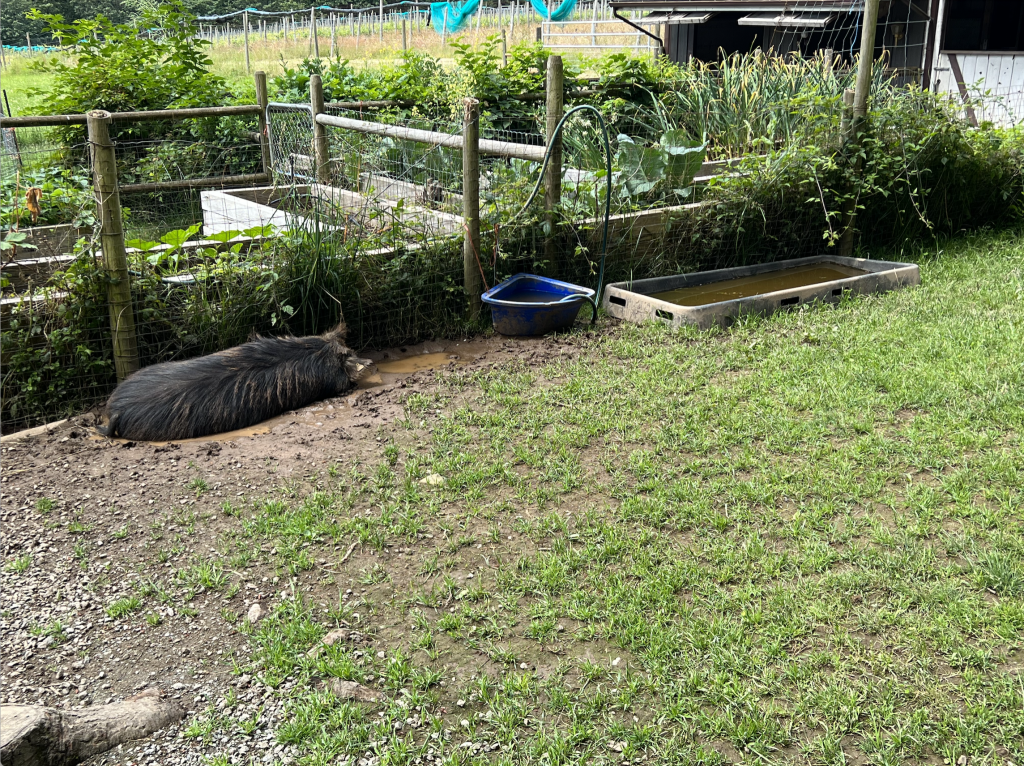
If the weather gets really hot (+30 degrees Celcius), I will sometimes run a mister out by the wallow and increase the bucket fill timers to ensure continuous cool water is accessible. Timers are great, but on super hot days, I am definitely out there checking on them regularly to make sure there hasn’t been a malfunction and everyone is well hydrated and has a way of cooling down. I never change herd structures on a super hot day – they can overheat squabbling over pecking order or a newcomer may be bullied away from essential water. I don’t take that risk.
Behaviour is another strategy that pigs use to deal with the heat. They often graze early or late in the day while it is cooler and nap in the shade during the heat of the day. Our pigs have access to lots of trees for shade, but shade sails or other secure structures can be helpful where trees are scarce.
During the spring and fall, wind storms are common on the coast. They often result in trees coming down and downed power lines. It is important to ensure shelters are not in areas where trees are likely to fall on them and that fences are checked for intactness after storms.
Fencing
As far as pigs go, Kunekune are easy on fences. The only time I’ve found them testing a fence is at mealtime to budge ahead of one of their buddies or a sow in heat that wants to go looking for love. Even in those cases, a 4′ wire fence is adequate. The key is to have a tight and low enough fence so they can’t get their nose under it. A fence that a pig can get its nose under (with the exception of electric) will be lifted in a heartbeat if the pigs are sufficiently motivated (think food or hormones). Here are a few various fences that work on our property.
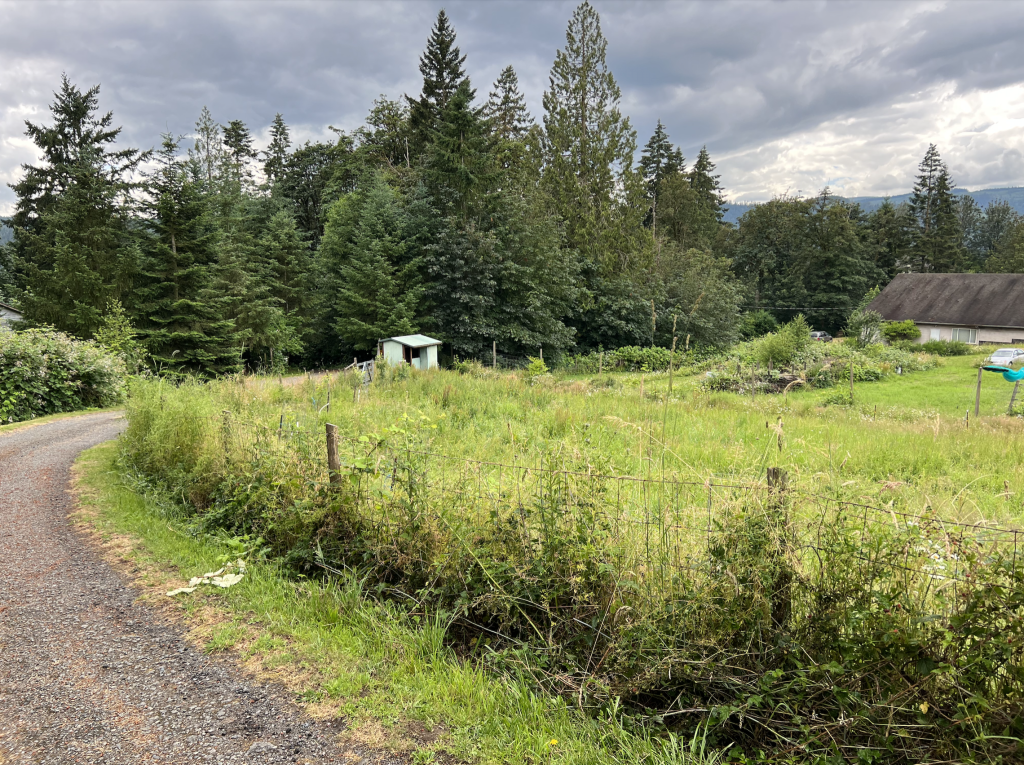


For predator protection, we have an 8′ perimeter fence. We have an orchard and vineyard so the entire property is well fenced. If we didn’t have a tall fence to start with or if we had more predator pressure, we would likely have put in an electric line on the top of a regular fence to keep bears from easily slipping over the fence. We get the odd deer or bear, but so far they have not stayed long or made trouble.
In the vineyard/pasture, we have 30″ by 16′ hog panels that we can erect between t-posts for temporary pastures and rotations. An electric fence could be used to cross fence the land, but our pigs would need to be trained to it first (it doesn’t take long). Cross fencing allows us to rotationally graze our stock and keep them out of the grapes and haskap when they are budding and fruiting. After our fruit has been harvested, we let the pigs right back in there with the vines and bushes. They keep the grass and weeds down while fertilizing. In the spring it always feels like we need more pigs! In the orchard, we have found that wire sleeves around immature trees has been effective at preventing damage. Pigs love a good scratch and until our trees can withstand a good rub, we will keep them wired

At the end of the day, there are lots of great ways to fence in and protect your property and Kunekune. What you use will depend a lot on your farm and personal preferences.


Thank you for sharing all that information -getting two Kunekune piglets very soon. Just doing our fencing. We do have coyotes in the area. Making our structure also.
is it necessary to change the straw bedding in the kune kune’s shed often if it is not generally soiled. I just add new straw from time to time and they kick out what they don’t want.
I clean it out before farrowing in the fall and spring but otherwise leave it. I’ve never had mites, but that’s the only reason I can think of changing it other than soiled bits. I mostly leave it through the year.
Thank you for your informative article. I have acquired mid Sept./24 Kunekune (20) pigs, helping my son not able (job move) to E. Kootenay from Sth. Interior. He had 3 sows, 2 boars, 15 offspring, plus equipment.
I live on acreage 60, Retired s.f/hobbiest/ .Sr.farmer, in Central Cariboo region NE of Williams Lake. I do not know your location the article was based on ?
The climate changes, this winter was a real challenge for wintering, had the huts, wire fencing and panels. I found it difficult feeding outside with rubber tubs, flipped and burried in snow my every day easter hunting..lo I feed alfalfa pellets mixed with warm water overnight,,making sure they have enough fluid intake..water freezing etc. during extreme -30c-+10c cool moist weather …they did learn to eat and play in the snow when I put hay forage out on sunny days.. kept them entertained active bringing body temp-up. I kept the youngest 6 under heat in my milking old barn. The 9 young stock(various ages) seperate area, outside in huts. All bedding, used a local log home mills, sawdust/shavings and purchased straw…kept filling them up as sunny days the sows would push it out. We all survived but..what an experience..with out the knowledge you shared reading your article here today.
I had to move all pigs around in mid March, vaccinate and rotate, seperate in gender, age groups, 3 sows for breeding, as soon as the steel panels (frozen in the ground) into my hayshed out of the elements of wind, melting ice/snow, wet spring, mud etc. All looking much better, very social and gaining more wieght. I find the dominant males eat faster than the girls..not fair 🙂 Soon all will be out grazing now that warmer weather is arriving, electric fencsing and wire panels…hope too train them not too till all the ground, grass, up..as they did last fall ! lo..they love rooting young aspen trees..eating roots an all.and found my rubarb patch..too!Not this year 🙂 Amanda Do you vaccinate? before sows farrow, young stock and how often? Can you keep boars with pregnant sows, when too seperate?
What live wieght ( not by age) for table before they eat all or any profit, pets or otherwise? How do you. accurately measure weight loss or gain by tape,scale or other? I purshased a pig tape having trouble with standing still..hard getting tape to measure around the girth etc.! Kunnies are smaller before beginning start of the tape, made for regular pigs. This F. senior (105lbs.) needs help! Some yearlings weigh more than I do.. Their cute, short legged, smart, lovable, trained to poop in their designated areas(quickly learn) can talkback and I swear they can read my mind…who’s teaching who ! These kunekunies when let out free or escape from area usually thru under my legs, have addapted without Fear, with all my grazing farm critters, horses, ponies, donkeys, turkeys plus 2 dogs they play with and protect..me too! Have taken many pictures of them eating along side of each other, sleeping with all in harmony. Sincerely, and thanks , Doreen
You are in a much colder region of BC than us, we are on the coast of Vancouver Island and it never snows more than a couple of weeks of the year. Finding bowls in the snow is no fun! Whispering Wind Farms does Kunekune and are in AB. They might be a good place to follow for winter tips and tricks. To answer you questions, I keep my boars separate after breeding, but you could get away with leaving them in unitl a couple of weeks before farrowing. I vaccinate my whole herd regularly according to my vets protocols which vary. I love Prairie Livestock Veterinarians, they have a vet who can mail you vaccines in BC. 200lbs is a good weight to take them to the butcher for us. We have specifically bred for growth and a relatively lean frame (as far as one gets for a Kunekune), pet style Kunekune can carry a lot of extra fat after 10 months to 1 year, so the best time will vary depending on your herd. The biggest impact on pigs eating your profit is when they start turning feed to mostly fat instead of muscle. I tape my herd and do a scaled weight when they turn 1. My recent yearlings were 224-240lbs at 12 months old and in “lean” condition for a Kunekune.
Thanks again for your input and early reply as well Amanda! When I need help to vaccinate mid. this Jan. 2025, our vets and feed suppliers had no idea of was species they were, thought they were hampsters. My son when he started to raise reg. stock.Kunies. now adaults,on his 6 acrea parcel 2 1/2 yrs. grazing on natural wild grass/mix with some wild seeded alfalfa. supplimented with Sure Crop Feed Rabbit pellets and Alfalfa hay during winter, from surrounded area farmers in Grindrod. loc. near Enderby, Sth. B.C. To get to butcher weight 24mth 200-240 lb. for lean condition. Last winter /24 one sow raised 9, Aug 2 hot summer last yr. another sow had 6 was seperated in pen, but killed 4 of here pigglets by ramming them against fence, injuring the rem. 2 which he botle fed until 6 weeks and suckling when they could both survived.
I feel due his lack of knoweledge ( orig. owners) feeding program of nutritent, lack of vitamins, etc. for Kunekune plus an unknown skin minge which they had. even though he vaccinated. He had diffiulty with sows not comming into colosterum after farrowing and dropping their milk. Ariving here in mid Sept. last year has been more than a challenge and yearlings still under weight for age. I vaccinated in Jan. 25, Mar, and will due again before into seperated areas, groups, before going out in pasture. The youngest stock are just now starting to scratch again( but not as severe) is this normal ? They are gaining weight now my feeding program and the weather.
I have been effected myself as well, monitoring all of us on the farm. I had lost 12% of my weight, and my unknown skin itch condition, slowly gaining back since after first treatment for myself in Mar.! I have talked to our Wild life and Indigenous lands Antropologist for B.C in Langley.
Is this normal reg. Kunekune pigs in DNA and for breeders raising them? or an overlooked unawareness when purchasing, as you prier mentioned in your post ?
Amanda, they say Kunekune pigs or reg. pig skin condition -itch/ loss of weight etc. to humans/ people is not tranferable or get enfected to their knowledge. Not in this case an I’m diligently with dertermination..on it..! Talking by experience to our Med.System as they have a serious lack of knowledge and with our B.C.ag. animal welfare. etc. I take by med.in pill form, dosage by weight, Ivermectin perscribed , insistad by me. as /when the herd is vaccined for internal/external parasites.by injection Ivermectine. Until I found your informative post and now this reply.
Amanda again thank you. I would like to know who or where: ?? That has the knowledge of Kune pigs vet. wise, that can help by understanding, for all my critters and I can be safe too! Properly guided of confidential concerns, I have expressed here within.
Alone here, copping with the exrta work, finanacial up keep, the health and welfare of raising Kunekune pigs on my mixed farm. I appreciate, give thanks for a healthy lifestyle and support the Agriculture Industry in B.C . Being part of good farm practices for upcomming future generations is my responsibility right now.
With gratitude, Doreen